Scotland Rocks...Discover Scotland’s story… one rock at a time
The Scottish Geologist Geology Rock Box, created in collaboration with CED Stone and Landscape, is a hands-on introduction to the three fundamental rock groups that shape our planet: Igneous, sedimentary and metamorphic.
Designed for curious beginners, students educators and rock lovers of all ages, each box contains 10 real rock specimens carefully selected by @scottishgeologist and supplied by CED stone - bringing geology out of the textbook and straight into your hands.
What’s inside the Rock Box?
10 authentic rock samples:
3 igneous rocks - formed from molten magma and lava
3 sedimentary rocks - built from layers of sediment through time
4 metamorphic rocks - transformed by heat, pressure and deformation
Each specimen is chosen to highlight clear textures, structures and features that help you see how rocks form and change.
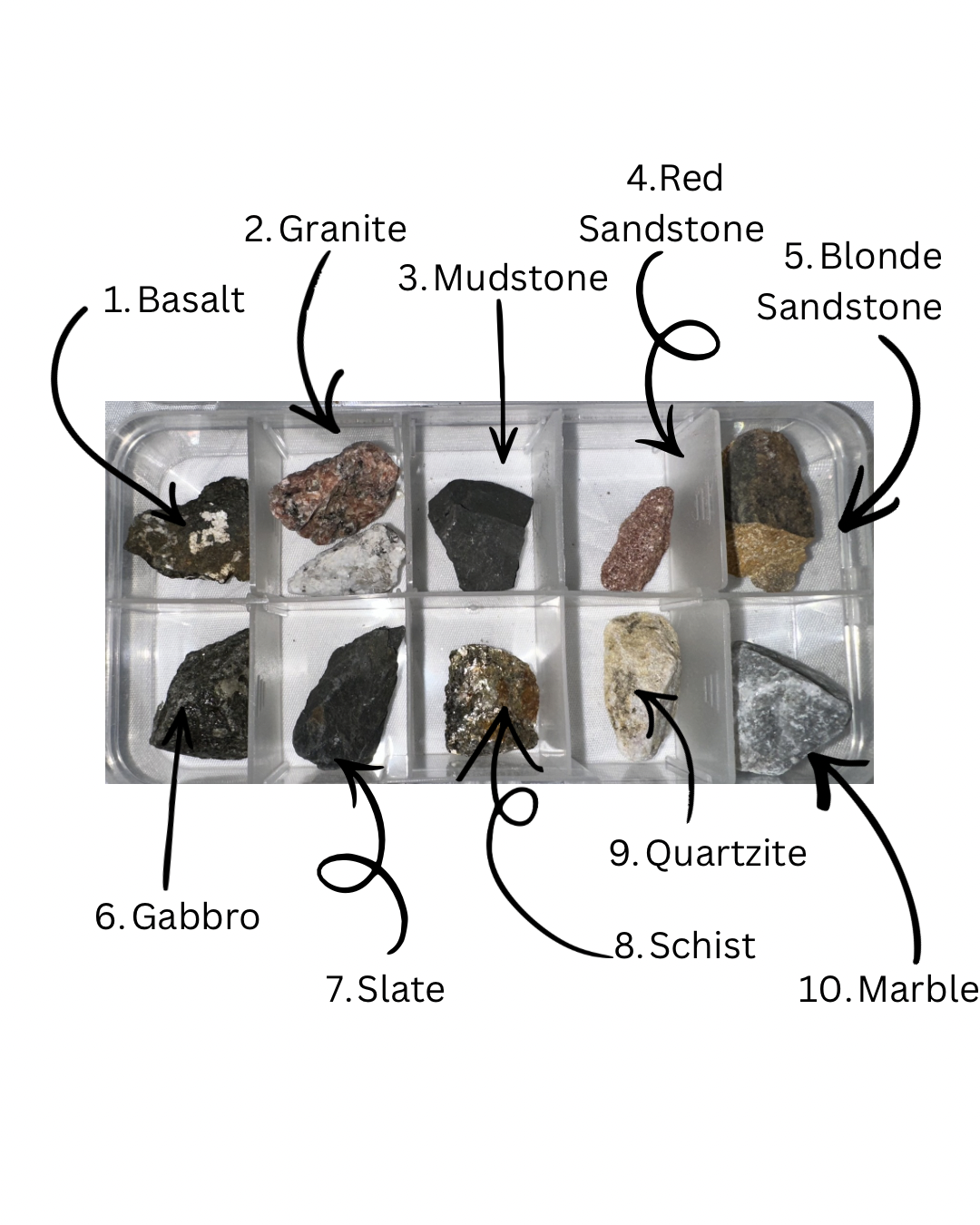
Basalt (igneous)
Basalt is a dark basic igneous rock, it can be an extrusive or instrusive igneous rock and forms from partial melting of the mantle (the layer underneath the crust) that is primarily made up of olivine and pyroxene. When you melt a bit of that material, then you form a magma/melt that is ‘basaltic’ in composition meaning it is basic or mafic meaning it is low in silica and rich in Mg (magnesium) and Fe (iron). Basalt is usually the terminology we give to a dark, fine grained (aphanitic) igneous rock that crystallised quite quickly giving it a that fine grained texture which basically means the crystals didn’t really have time to grow which is what happens when it comes into contact with the cold air, or erupts into the cold water. In some cases it cools that quickly forming a volcanic glass. Anyway, this lava that you have in your box is Amygdaloidal Basalt from Isle of Skye. When the lava erupts at the surface it releases the gases and volatiles it contains creating small vesicles (holes/cavities) which are then later filled with other minerals when hydrothermal fluids are running through the rock and precipitating out different minerals. So aye… your basically holding a piece of lava that erupted out of a volcano 60 odd million years ago when Scotland started drifting apart from Greenland and America and that.
Granite (igneous)
Granite is a silica rich intrusive igneous rock, manly forming plutonic rocks (magma chambers and that). Intrusive rocks form in the crust, extrusive igneous rocks form at the surface and this is when we call it lava. A granite tells you a story that it used to be a magma - because it has coarse grained crystals (>2mm) it tells you that it took a long time for that crystal to grow and form the granite. You get different types of granite but they are all usually rich in silica rich minerals such as quartz, plagioclase, K-feldspar, biotite, muscovite and amphibole. Granites can form in two main ways - when you have partial melting of the crust or by fractional crystallisation of a basic (mafic lava) or assimilation of a magma chamber where some of the outer rocks surrounding the magma chamber fall into the magma chamber and change its chemistry… this really does get complicated when you really start looking into it. The granite in your box is from the Cairngorm mountains and formed around 415 to 425 million years ago during the Caledonian orogeny - that event that I’m always going on about in my videos. depending on what you previously melted before, depends on the type of granite that forms - you can get S-type granites which form from partial melting of sedimentary/meta-sedimentary rocks, M-type granites which form from the fractional crystallisation of the mantle or I-type granites which is the partial melting of igneous rocks. There’s a lot of chemistry involved but to keep it simple - we will just stick to the basics. You get partial melting of the crust at convergent plate boundaries where two plates meet - when you have a lot of crustal thickening you usually get a lot of partial melting. When we look at a geology map of Scotland, we can actually see red blobs exposed at the surface which are the magma chambers (igneous intrusions) of ancient volcanoes that existed 420 million years ago in Scotland during the Caledonian orogeny.
Mudstone (sedimentary)
Mudstone is a sedimentary rock that forms in deep marine environments - this can be in the ocean or in a lake where you have the suspension of fine grained sediments (<0.063mm) into a marine like environment. although sometimes we do come across other places where we can see that layers of mud have accumulated over geological time. as the sediment accumulates it usually forms thin to thick laminations of mud which compact and cement together over geological time forming a mudstone. Sometimes we can find fossils in mudstone - especially if it formed in a marine environment but in this case, the rock in your box is just mudstone. It’s from the carboniferous period (299 to 359 million years ago) of Scotland when Scotland used to be located at the equator and sometimes the sea level would rise causing mudstone to be deposited.
Red Sandstone
This sandstone is from the permian period, from the new red sandstone group of Scotland - A lot of this rock has been quarried and used in the red sandstone tennaments we see in the major cities and towns of Scotland. It formed by the accumulation of sand sized particles that were carried by the wind and deposited in desert like conditions - this is why it has a red colour because the minerals have been coated in iron oxides due to the arid enviornments. Scotland was yet again completely different during the permian period and bang on the middle of the super continent of Pangea which meant there wasn’t much water at all. We can see some large scale sand dunes in these rocks across the UK which is pretty cool and unique.
Blonde Sandstone
This sandstone is from the Midland Valley of Scotland and was deposited during the carboniferous period by rivers and that when scotland was situated at the equator. The environment was a lot more wetter and humid 330 odd million years ago and the sea level fluctuated during this period of time which allowed for a variety of different sedimentary rocks to form in different environments, blonde sandstone being one of them. Sometimes the sandstone is micaceous - meaning you can see the dark mica minerals sparkle away. other times the sandstone contains quartz, plagioclase and a tiny amount of mica - the minerals may vary from sample to sample but they are still fluvial in origin.
Gabbro
Gabbro is Basalts coarse grained pal - They both have the same composition but one of them formed in the crust as an intrusive igneous rock either in a pluton/batholith and the other forms from rapid cooling of magma either close to or at the surface. Gabbro is coarse grained telling you it took awhile for the crystals to crystallise into the state there in the now. It’s dark in colour which tells you it’s mafic in composition (Mg and Fe rich) (45-55% silica content) and is rich in minerals such as olivine, pyroxene and plagioclase feldspar. We can find Gabbro on the Isle of Skye (Black Cullins), Isle of Mull, Ardnumurchan, isle of Rum that are all related to the opening of the Atlantic Ocean 60 odd million years ago so these are relatively young rocks in Scotland’s geological history. You can also find microgabbro and gabbro that makes up some of the volcanic plugs, dykes, and sills from the carboniferous period in the Midland valley when Scotland had a lot of extension happening 340 million years ago and you can also find some gabbro in the north east grampian highlands that are related to the Caledonian orogeny as the plate subjected underneath the laurentian plate - they think it caused some partial melting of the mantle which formed theses gabbros which are actually pretty important as they contain critical minerals. Just think about it this way - your holding a magma chamber in your hand.
Slate (Metamorphic)
Slate is a low grade metamorphic rock - a metamorphic rock is a rock that’s changed over geological time either due to heat (contact metamorphism or heat and pressure (regional metamorphism - convergent plate boundary). You can find a lot of slate within the Grampian highlands of Scotland where we have had a lot of old sedimentary rocks that have been metamorphosed into meta-sedimentary rocks during the Caledonian orogeny that form part of the Dalradian supergroup. This rock used to look like the mudstone that you have in your box but its been caught up in that mountain building event - been put under low temperatures (around 300 degrees celsius) and pressures to transform into a slate.
Schist (Metamorphic)
Schist is a medium to high grade metamorphism - it forms when a mudstone is put under higher temperatures and pressures within that mountain belt and shows what’s known as schistosity where all of the mica minerals recrystallise and line up.
Quartzite (Metamorphic)
Marble (Metamorphic)