Friday 18th to Tuesday 22nd June 2027 | Tuesday 13th to Saturday 17th July 2027 | Starting at £1750ppThe Geology of Isle of Mull, Iona and Staffa
Explore Scotland’s ancient volcanoes, walk on to a magma chamber and discover the dramatic landscapes that shaped the inner Hebrides
5 Day Geological Expedition
From the oldest rocks to the youngest rocks in Scotland
Explore the geology of Mull, Iona and Staffa through the eyes of a geologist, discovering ancient volcanoes, the roots of mountains, and some of the oldest rocks in Europe.
Join me on an unforgettable five-day geological expedition exploring one of the most spectacular volcanic landscapes in Europe.
From towering sea cliffs and lava plateaus to ancient magma chambers, ring dykes and world-famous basalt columns, this expedition uncovers the incredible geological story behind Mull, Iona and Staffa.
Around 60 million years ago, western Scotland was transformed by immense volcanic activity as the North Atlantic Ocean began to open. Giant volcanoes erupted across the landscape, feeding vast lava fields and creating the rugged mountains and islands we see today.
Today, those volcanoes have long since disappeared, but their internal plumbing systems remain beautifully exposed, allowing us to walk through the roots of ancient volcanoes and discover how they once worked.
Whether you're completely new to geology or already have a passion for rocks, this expedition will help you understand these incredible landscapes in a completely new way.
Tour Highlights
Discover ancient volcanoes, mountain belts and spectacular sea cliffs.
Explore almost three billion years of Earth's history.
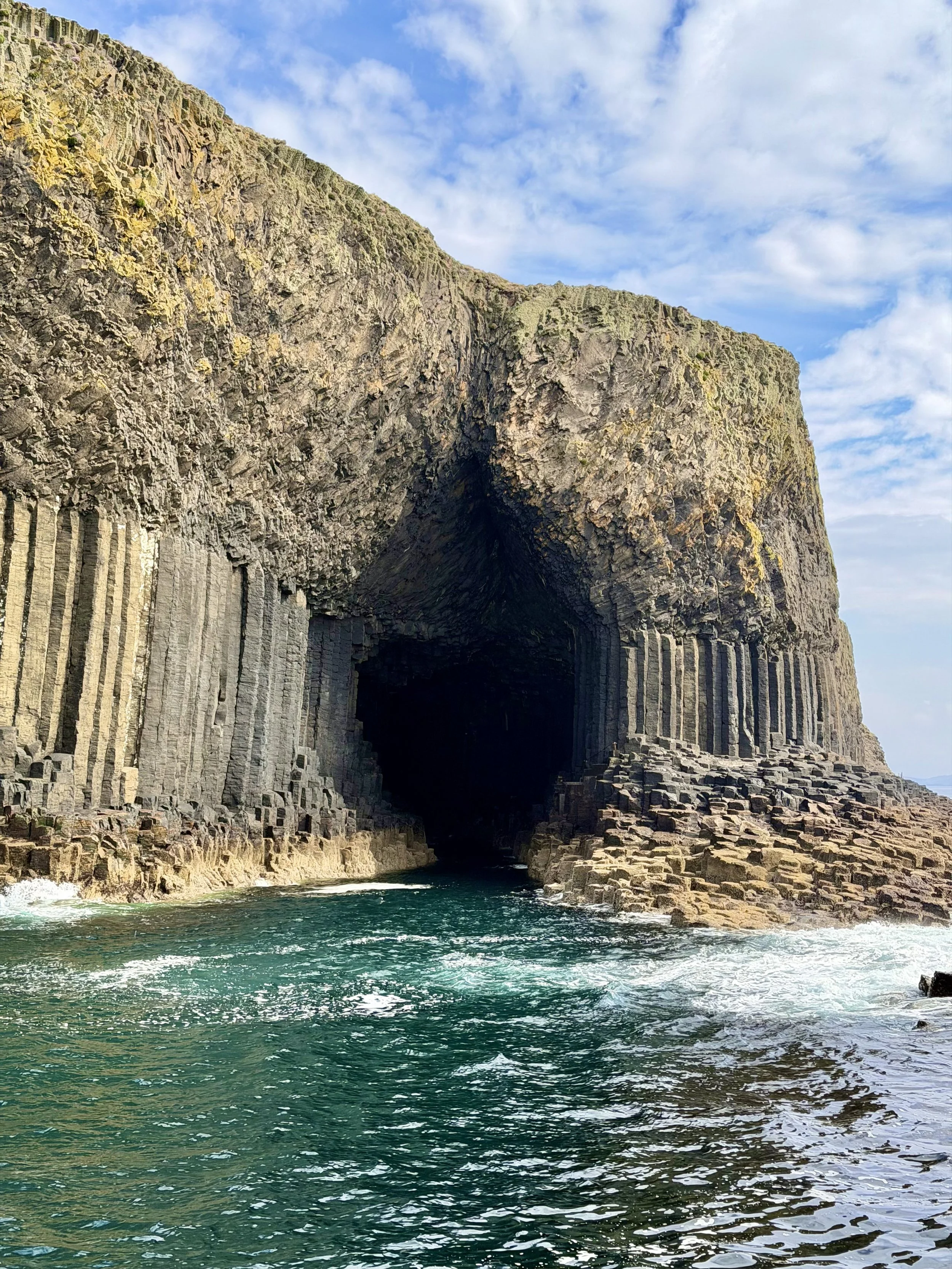
Visit Fingal's Cave and Staffa's spectacular basalt columns.
Discover Iona's famous Lewisian Gneiss.
Learn how giant volcanoes are built from the inside out.
Walk through lava flows, magma chambers and volcanic intrusions.
Small group experience with plenty of opportunities to ask questions and examine the rocks up close.
Four nights' accommodation on Mull.
Guided throughout by Scottish Geologist.
This is far more than a sightseeing holiday. It's an immersive geological adventure that will completely change the way you see Scotland—and the Earth beneath your feet.
Itinerary
Day 1 – Ancient Mountains and Metamorphic Rocks
Ardalanish and the Ross of Mull
Guests meet in Oban in the morning before travelling by ferry to Mull and continuing south to the Ross of Mull. To get to Oban you can get on trains from Glasgow central which take 2 hours 25 mins.
Our geological journey begins with some of the oldest rocks encountered during the expedition. At Ardalanish Bay, we’ll explore Moine metasedimentary rocks that began as ancient sands and muds before being buried, folded and transformed during major episodes of mountain building.
We’ll investigate the effects of regional metamorphism before examining how the later intrusion of the Ross of Mull Granite heated and altered the surrounding rocks. Ardalanish is particularly well known for its metamorphic minerals and provides the perfect place to introduce how temperature, pressure and magma can transform pre-existing rocks.
Highlights
Ferry from Oban to Mull
Ardalanish Bay
Moine metamorphic rocks
Psammite, semipelite and pelite
Folding and deformation
Regional metamorphism
Contact metamorphism
Kyanite, andalusite and sillimanite
Ross of Mull Granite
Welcome evening and introduction to the expedition
This gives you a strong opening because guests begin with the rocks that existed long before Mull’s volcanoes formed.
Day 2 – Ancient Crust Meets a Volcanic Island
Iona and Staffa
Today we continue through geological time by exploring two islands that preserve dramatically different chapters in Scotland’s history.
We’ll first cross to Iona, where ancient gneisses, metamorphic rocks and granitic intrusions reveal the island’s deep geological foundations. We’ll examine how these rocks relate to the ancient continental crust exposed elsewhere along Scotland’s northwest margin.
Later, weather permitting, we’ll travel by boat to Staffa. Here, the geological story jumps forward to around 60 million years ago, when basaltic lava erupted during the opening of the North Atlantic.
At Staffa, we’ll explore the world-famous basalt columns and Fingal’s Cave, learning how thick lava flows cooled, contracted and fractured into their remarkable polygonal shapes.
Highlights
Ferry to Iona
Ancient continental rocks
Lewiston Gneiss and metamorphic rocks
Granitic intrusions
Boat trip to Staffa
Fingal’s Cave
Columnar basalt
Lava cooling and contraction
Coastal erosion
Puffins, depending on season
Iona Abby
Day 3 – A Lost Forest Beneath the Lava
MacCulloch’s Fossil Tree
Today we move fully into Mull’s volcanic story.
We’ll travel by private boat along Mull’s spectacular western coastline towards the remote Ardmeanach Peninsula. From the sea, we’ll be able to examine the enormous succession of basalt lava flows that built the early Mull volcano.
Our aim will be to visit MacCulloch’s Fossil Tree, subject to safe sea and landing conditions. The site preserves the mould of a tree that was engulfed by lava around 60 million years ago, providing extraordinary evidence that forests became established between successive volcanic eruptions.
This day reveals that Mull’s lava plateau was not formed in one catastrophic event. Instead, eruption followed eruption, with periods of calm in between when soils developed and vegetation returned.
Highlights
Private coastal boat expedition
Ardmeanach Peninsula
MacCulloch’s Fossil Tree
Successive basalt lava flows
Fossil soils between eruptions
Evidence of ancient forests
Columnar jointing
Volcanic cliffs
Coastal geomorphology
Please note that landing beside the fossil tree is dependent on weather, sea and tidal conditions.
Day 4 – Inside the Mull Volcano
Magma Chambers, Ring Dykes and Caldera Collapse
After exploring the lava fields, we now travel deeper into the volcanic system.
Today we enter the eroded heart of the Mull Central Complex, where millions of years of erosion have exposed rocks that originally crystallised beneath the volcano.
We’ll investigate how magma moved through the crust, how repeated intrusions built the volcanic centre and how collapse structures controlled the emplacement of later magma.
Locations
Glen More
Loch Ba
Loch Ba Ring Dyke
Ben More viewpoints
Gribun
Accessible parts of the Mull Central Complex
Day 5 – Fire, Ice and the Modern Landscape
Final Mull Exploration and Return to Oban
Our final day brings together the geological story of the entire expedition.
We’ll explore an additional part of Mull’s volcanic landscape, choosing the best locations according to weather, access and the group’s interests. This could include lava flows, dykes, coastal features or viewpoints across the central volcanic complex.
We’ll also examine how glaciers and the modern Atlantic coastline have reshaped the ancient rocks and volcanic structures encountered throughout the week.
We’ll then return to Craignure for the ferry back to Oban.
Highlights
Final volcanic locality
Glacial erosion
Coastal landscape development
Review of Mull’s geological timeline
Ferry back to Oban
End of the expedition
Why is this tour different?
This isn't simply a sightseeing tour of Scotland's west coast.
It's a journey inside an ancient volcano.
Over five days you'll discover how volcanoes erupt, how magma moves through the crust and how millions of years of erosion have exposed the hidden plumbing system beneath one of Britain's greatest volcanic provinces.
By the end of the expedition you'll understand not only how Mull, Staffa and Ardnamurchan formed—but how volcanoes work anywhere on Earth.
What to expect
Expect relaxed days filled with spectacular scenery, fascinating geology and plenty of opportunities to stop for photographs.
We'll combine short walks, boat trips, coastal sections and mountain viewpoints while gradually building the geological story throughout the week.
Every day introduces another chapter in the evolution of Scotland's ancient volcanoes.
Suitable for complete beginners as well as experienced geology enthusiasts.
Small group experience
Geology-focused guiding
Suitable for enthusiastic beginners and geology lovers alike
Scenic stops throughout
Relaxed, friendly and informative atmosphere
🚶 Average walking: 3–5 miles (5–8 km) per day
🥾 Terrain: Beaches, coastal paths, grassy tracks, rocky shorelines and occasional uneven ground.
⛰️ Difficulty: Moderate. Suitable for anyone with a reasonable level of fitness who is comfortable walking on uneven terrain.
📸 Pace: Relaxed, with frequent stops for photography, geology and wildlife.
What’s Included?
4 nights in self catering accommodation with shared bathrooms on Isle of Mull - 2 Twins, 2 doubles and and 2 single rooms available with 2 bathrooms shared between 2 separate self catering apartments. Please note that everyone will get a separate room, double rooms are reserved for couples that book on and twins for two friends who are happy to share.
5 days of guided geological touring
Transport throughout the tour from Oban
All inter-island ferry crossings
Expert geology interpretation by Scottish Geologist
Geological field guide and information pack
Breakfast and evening meals included at separate restaurants throughout the trip depending on where we are going to visit (food only)
Small group experience
What’s Not Included
Drinks not included with meals
Personal travel insurance
Lunches
Transport to and from Oban
Optional activities outside the itinerary
Price
From £1,750 per person
Includes accommodation, transport during the expedition, ferry crossings, boat trip to Staffa (weather permitting), private boat to McCullocks Tree, Meals, geological guiding and field materials.
We will confirm the running of this tour once 3 people book on.
From the oldest rocks to youngest rocks ones in Scotland
Explore the geology of Mull, Iona and Staffa through the eyes of a geologist, discovering ancient volcanoes, the roots of mountains, and some of the oldest rocks in Europe.
Join me on an unforgettable five-day geological expedition exploring one of the most spectacular volcanic landscapes in Europe.
From towering sea cliffs and lava plateaus to ancient magma chambers, ring dykes and world-famous basalt columns, this expedition uncovers the incredible geological story behind Mull, Iona and Staffa.
Around 60 million years ago, western Scotland was transformed by immense volcanic activity as the North Atlantic Ocean began to open. Giant volcanoes erupted across the landscape, feeding vast lava fields and creating the rugged mountains and islands we see today.
Today, those volcanoes have long since disappeared, but their internal plumbing systems remain beautifully exposed, allowing us to walk through the roots of ancient volcanoes and discover how they once worked.
Whether you're completely new to geology or already have a passion for rocks, this expedition will help you understand these incredible landscapes in a completely new way.
Tour Highlights
Discover ancient volcanoes, mountain belts and spectacular sea cliffs.
Explore almost three billion years of Earth's history.
Visit Fingal's Cave and Staffa's spectacular basalt columns.
Discover Iona's famous Lewisian Gneiss.
Learn how giant volcanoes are built from the inside out.
Walk through lava flows, magma chambers and volcanic intrusions.
Small group experience with plenty of opportunities to ask questions and examine the rocks up close.
Four nights' accommodation on Mull.
Guided throughout by Scottish Geologist.
This is far more than a sightseeing holiday. It's an immersive geological adventure that will completely change the way you see Scotland—and the Earth beneath your feet.
Itinerary
Day 1 – Ancient Mountains and Metamorphic Rocks
Ardalanish and the Ross of Mull
Guests meet in Oban in the morning before travelling by ferry to Mull and continuing south to the Ross of Mull. To get to Oban you can get on trains from Glasgow central which take 2 hours 25 mins.
Our geological journey begins with some of the oldest rocks encountered during the expedition. At Ardalanish Bay, we’ll explore Moine metasedimentary rocks that began as ancient sands and muds before being buried, folded and transformed during major episodes of mountain building.
We’ll investigate the effects of regional metamorphism before examining how the later intrusion of the Ross of Mull Granite heated and altered the surrounding rocks. Ardalanish is particularly well known for its metamorphic minerals and provides the perfect place to introduce how temperature, pressure and magma can transform pre-existing rocks.
Highlights
Ferry from Oban to Mull
Ardalanish Bay
Moine metamorphic rocks
Psammite, semipelite and pelite
Folding and deformation
Regional metamorphism
Contact metamorphism
Kyanite, andalusite and sillimanite
Ross of Mull Granite
Welcome evening and introduction to the expedition
This gives you a strong opening because guests begin with the rocks that existed long before Mull’s volcanoes formed.
Day 2 – Ancient Crust Meets a Volcanic Island
Iona and Staffa
Today we continue through geological time by exploring two islands that preserve dramatically different chapters in Scotland’s history.
We’ll first cross to Iona, where ancient gneisses, metamorphic rocks and granitic intrusions reveal the island’s deep geological foundations. We’ll examine how these rocks relate to the ancient continental crust exposed elsewhere along Scotland’s northwest margin.
Later, weather permitting, we’ll travel by boat to Staffa. Here, the geological story jumps forward to around 60 million years ago, when basaltic lava erupted during the opening of the North Atlantic.
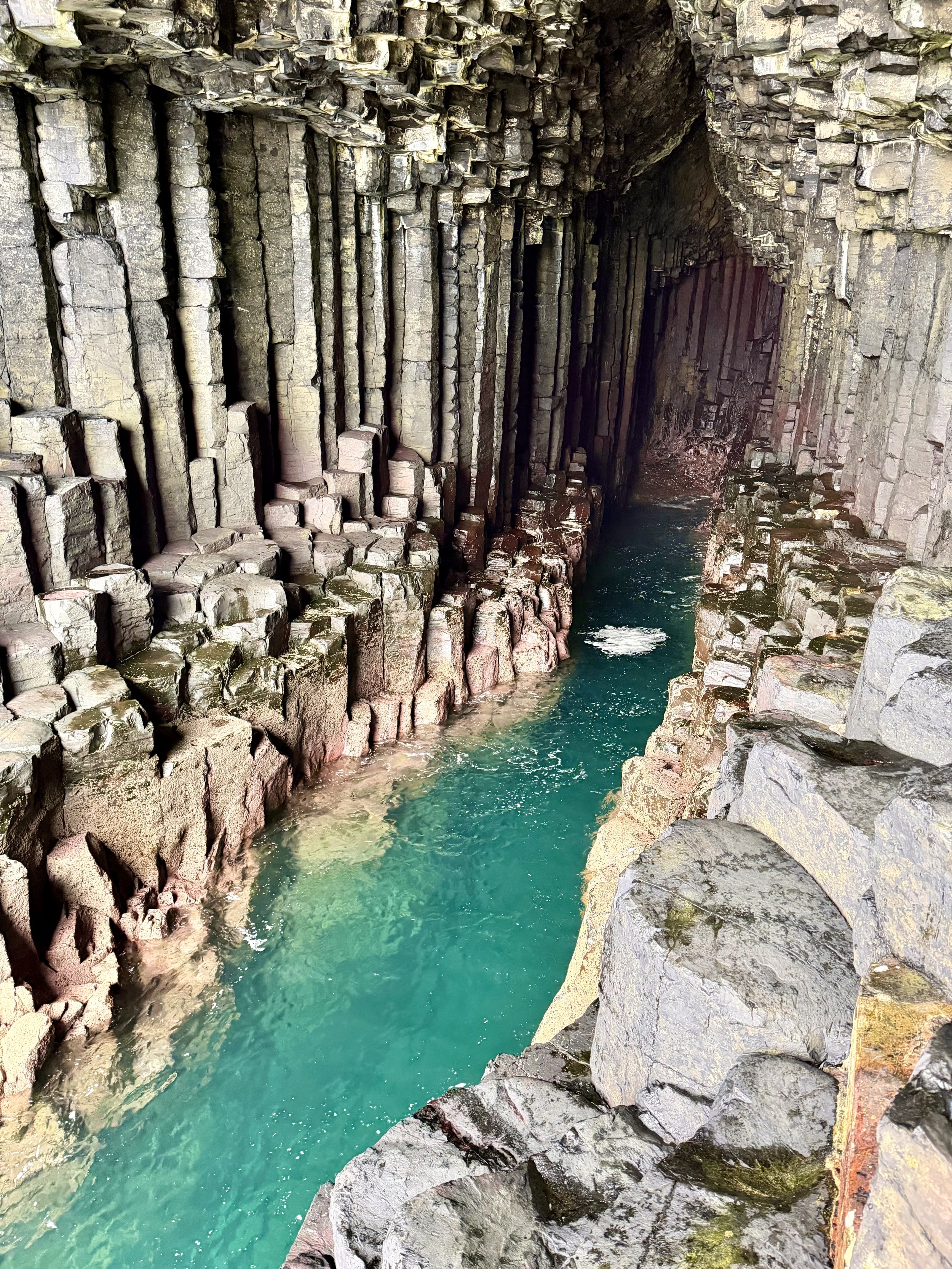
At Staffa, we’ll explore the world-famous basalt columns and Fingal’s Cave, learning how thick lava flows cooled, contracted and fractured into their remarkable polygonal shapes.
Highlights
Ferry to Iona
Ancient continental rocks
Lewiston Gneiss and metamorphic rocks
Granitic intrusions
Boat trip to Staffa
Fingal’s Cave
Columnar basalt
Lava cooling and contraction
Coastal erosion
Puffins, depending on season
Iona Abby
Day 3 – A Lost Forest Beneath the Lava
MacCulloch’s Fossil Tree
Today we move fully into Mull’s volcanic story.
We’ll travel by private boat along Mull’s spectacular western coastline towards the remote Ardmeanach Peninsula. From the sea, we’ll be able to examine the enormous succession of basalt lava flows that built the early Mull volcano.
Our aim will be to visit MacCulloch’s Fossil Tree, subject to safe sea and landing conditions. The site preserves the mould of a tree that was engulfed by lava around 60 million years ago, providing extraordinary evidence that forests became established between successive volcanic eruptions.
This day reveals that Mull’s lava plateau was not formed in one catastrophic event. Instead, eruption followed eruption, with periods of calm in between when soils developed and vegetation returned.
Highlights
Private coastal boat expedition
Ardmeanach Peninsula
MacCulloch’s Fossil Tree
Successive basalt lava flows
Fossil soils between eruptions
Evidence of ancient forests
Columnar jointing
Volcanic cliffs
Coastal geomorphology
Please note that landing beside the fossil tree is dependent on weather, sea and tidal conditions.
Day 4 – Inside the Mull Volcano
Magma Chambers, Ring Dykes and Caldera Collapse
After exploring the lava fields, we now travel deeper into the volcanic system.
Today we enter the eroded heart of the Mull Central Complex, where millions of years of erosion have exposed rocks that originally crystallised beneath the volcano.
We’ll investigate how magma moved through the crust, how repeated intrusions built the volcanic centre and how collapse structures controlled the emplacement of later magma.
Locations
Glen More
Loch Ba
Loch Ba Ring Dyke
Ben More viewpoints
Gribun
Accessible parts of the Mull Central Complex
Day 5 – Fire, Ice and the Modern Landscape
Final Mull Exploration and Return to Oban
Our final day brings together the geological story of the entire expedition.
We’ll explore an additional part of Mull’s volcanic landscape, choosing the best locations according to weather, access and the group’s interests. This could include lava flows, dykes, coastal features or viewpoints across the central volcanic complex.
We’ll also examine how glaciers and the modern Atlantic coastline have reshaped the ancient rocks and volcanic structures encountered throughout the week.
We’ll then return to Craignure for the ferry back to Oban.
Highlights
Final volcanic locality
Glacial erosion
Coastal landscape development
Review of Mull’s geological timeline
Ferry back to Oban
End of the expedition
Why is this tour different?
This isn't simply a sightseeing tour of Scotland's west coast.
It's a journey inside an ancient volcano.
Over five days you'll discover how volcanoes erupt, how magma moves through the crust and how millions of years of erosion have exposed the hidden plumbing system beneath one of Britain's greatest volcanic provinces.
By the end of the expedition you'll understand not only how Mull, Staffa and Ardnamurchan formed—but how volcanoes work anywhere on Earth.
What to expect
Expect relaxed days filled with spectacular scenery, fascinating geology and plenty of opportunities to stop for photographs.
We'll combine short walks, boat trips, coastal sections and mountain viewpoints while gradually building the geological story throughout the week.
Every day introduces another chapter in the evolution of Scotland's ancient volcanoes.
Suitable for complete beginners as well as experienced geology enthusiasts.
Small group experience
Geology-focused guiding
Suitable for enthusiastic beginners and geology lovers alike
Scenic stops throughout
Relaxed, friendly and informative atmosphere
🚶 Average walking: 3–5 miles (5–8 km) per day
🥾 Terrain: Beaches, coastal paths, grassy tracks, rocky shorelines and occasional uneven ground.
⛰️ Difficulty: Moderate. Suitable for anyone with a reasonable level of fitness who is comfortable walking on uneven terrain.
📸 Pace: Relaxed, with frequent stops for photography, geology and wildlife.
What’s Included?
4 nights in self catering accommodation with shared bathrooms on Isle of Mull - 2 Twins, 2 doubles and and 2 single rooms available with 2 bathrooms shared between 2 separate self catering apartments. There may be a 3rd apartment added on if more than 6 people book on. Please note that everyone will get a separate room, double rooms are reserved for couples that book on and twins for two friends who are happy to share.
5 days of guided geological touring
Transport throughout the tour from Oban
All inter-island ferry crossings
Expert geology interpretation by Scottish Geologist
Geological field guide and information pack
Breakfast, lunch and evening meals included at separate restaurants throughout the trip depending on where we are going to visit (food only). Packed lunch will be provided - please let Luisa know if you have any dietary requirements at time of booking.
Small group experience
What’s Not Included
Drinks not included with meals
Transport to and from Oban
Personal travel insurance
Optional activities outside the itinerary
Price
From £1,750 per person
Includes accommodation, transport during the expedition, ferry crossings, boat trip to Staffa (weather permitting), private boat to McCullocks Tree, Meals, geological guiding and field materials.
We will confirm the running of this tour once 3 people book on.
From the oldest to youngest rocks in Scotland
Explore the geology of Mull, Iona and Staffa through the eyes of a geologist, discovering ancient volcanoes, the roots of mountains, and some of the oldest rocks in Europe.
Join me on an unforgettable five-day geological expedition exploring one of the most spectacular volcanic landscapes in Europe.
From towering sea cliffs and lava plateaus to ancient magma chambers, ring dykes and world-famous basalt columns, this expedition uncovers the incredible geological story behind Mull, Iona, Staffa and Ardnamurchan.
Around 60 million years ago, western Scotland was transformed by immense volcanic activity as the North Atlantic Ocean began to open. Giant volcanoes erupted across the landscape, feeding vast lava fields and creating the rugged mountains and islands we see today.
Today, those volcanoes have long since disappeared, but their internal plumbing systems remain beautifully exposed, allowing us to walk through the roots of ancient volcanoes and discover how they once worked.
Whether you're completely new to geology or already have a passion for rocks, this expedition will help you understand these incredible landscapes in a completely new way.
Tour Highlights
Discover ancient volcanoes, mountain belts and spectacular sea cliffs.
Explore almost three billion years of Earth's history.
Visit Fingal's Cave and Staffa's spectacular basalt columns.
Discover Iona's famous Lewisian Gneiss.
Learn how giant volcanoes are built from the inside out.
Walk through lava flows, magma chambers and volcanic intrusions.
Small group experience with plenty of opportunities to ask questions and examine the rocks up close.
Four nights' accommodation on Mull.
Guided throughout by Scottish Geologist.
This is far more than a sightseeing holiday. It's an immersive geological adventure that will completely change the way you see Scotland—and the Earth beneath your feet.
Itinerary
Day 1 – Ancient Mountains and Metamorphic Rocks
Ardalanish and the Ross of Mull
Guests meet in Oban in the morning before travelling by ferry to Mull and continuing south to the Ross of Mull. To get to Oban you can get on trains from Glasgow central which take 2 hours 25 mins.
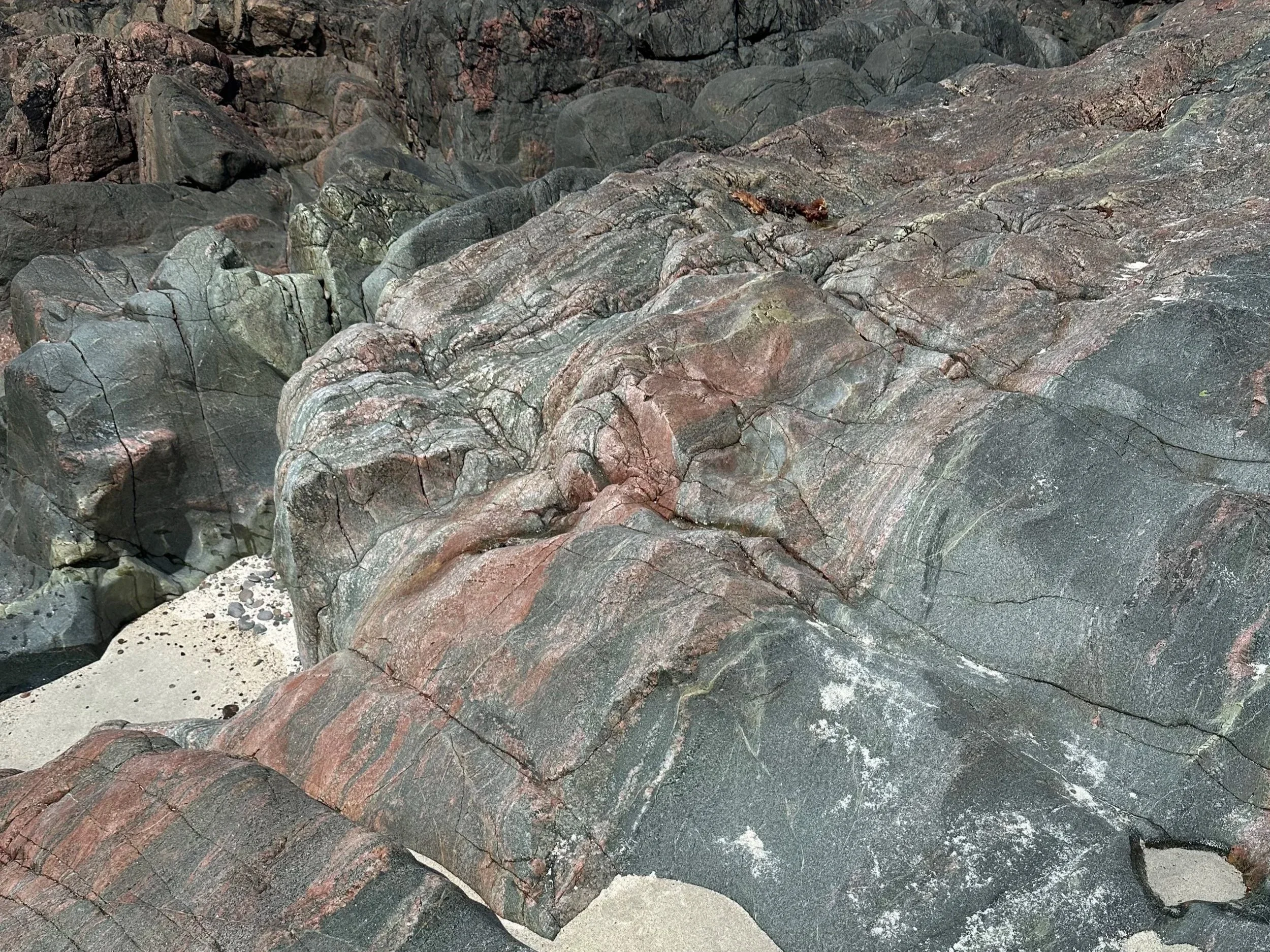
Our geological journey begins with some of the oldest rocks encountered during the expedition. At Ardalanish Bay, we’ll explore Moine metasedimentary rocks that began as ancient sands and muds before being buried, folded and transformed during major episodes of mountain building.
We’ll investigate the effects of regional metamorphism before examining how the later intrusion of the Ross of Mull Granite heated and altered the surrounding rocks. Ardalanish is particularly well known for its metamorphic minerals and provides the perfect place to introduce how temperature, pressure and magma can transform pre-existing rocks.
Highlights
Ferry from Oban to Mull
Ardalanish Bay
Moine metamorphic rocks
Psammite, semipelite and pelite
Folding and deformation
Regional metamorphism
Contact metamorphism
Kyanite, andalusite and sillimanite
Ross of Mull Granite
Welcome evening and introduction to the expedition
This gives you a strong opening because guests begin with the rocks that existed long before Mull’s volcanoes formed.
Day 2 – Ancient Crust Meets a Volcanic Island
Iona and Staffa
Today we continue through geological time by exploring two islands that preserve dramatically different chapters in Scotland’s history.
We’ll first cross to Iona, where ancient gneisses, metamorphic rocks and granitic intrusions reveal the island’s deep geological foundations. We’ll examine how these rocks relate to the ancient continental crust exposed elsewhere along Scotland’s northwest margin.
Later, weather permitting, we’ll travel by boat to Staffa. Here, the geological story jumps forward to around 60 million years ago, when basaltic lava erupted during the opening of the North Atlantic.
At Staffa, we’ll explore the world-famous basalt columns and Fingal’s Cave, learning how thick lava flows cooled, contracted and fractured into their remarkable polygonal shapes.
Highlights
Ferry to Iona
Ancient continental rocks
Lewiston Gneiss and metamorphic rocks
Granitic intrusions
Boat trip to Staffa
Fingal’s Cave
Columnar basalt
Lava cooling and contraction
Coastal erosion
Puffins, depending on season
Iona Abby
Day 3 – A Lost Forest Beneath the Lava
MacCulloch’s Fossil Tree
Today we move fully into Mull’s volcanic story.
We’ll travel by private boat along Mull’s spectacular western coastline towards the remote Ardmeanach Peninsula. From the sea, we’ll be able to examine the enormous succession of basalt lava flows that built the early Mull volcano.
Our aim will be to visit MacCulloch’s Fossil Tree, subject to safe sea and landing conditions. The site preserves the mould of a tree that was engulfed by lava around 60 million years ago, providing extraordinary evidence that forests became established between successive volcanic eruptions.
This day reveals that Mull’s lava plateau was not formed in one catastrophic event. Instead, eruption followed eruption, with periods of calm in between when soils developed and vegetation returned.
Highlights
Private coastal boat expedition
Ardmeanach Peninsula
MacCulloch’s Fossil Tree
Successive basalt lava flows
Fossil soils between eruptions
Evidence of ancient forests
Columnar jointing
Volcanic cliffs
Coastal geomorphology
Please note that landing beside the fossil tree is dependent on weather, sea and tidal conditions.
Day 4 – Inside the Mull Volcano
Magma Chambers, Ring Dykes and Caldera Collapse
After exploring the lava fields, we now travel deeper into the volcanic system.
Today we enter the eroded heart of the Mull Central Complex, where millions of years of erosion have exposed rocks that originally crystallised beneath the volcano.
We’ll investigate how magma moved through the crust, how repeated intrusions built the volcanic centre and how collapse structures controlled the emplacement of later magma.
Locations
Glen More
Loch Ba
Loch Ba Ring Dyke
Ben More viewpoints
Gribun
Accessible parts of the Mull Central Complex
Day 5 – Fire, Ice and the Modern Landscape
Final Mull Exploration and Return to Oban
Our final day brings together the geological story of the entire expedition.
We’ll explore an additional part of Mull’s volcanic landscape, choosing the best locations according to weather, access and the group’s interests. This could include lava flows, dykes, coastal features or viewpoints across the central volcanic complex.
We’ll also examine how glaciers and the modern Atlantic coastline have reshaped the ancient rocks and volcanic structures encountered throughout the week.
We’ll then return to Craignure for the ferry back to Oban.
Highlights
Final volcanic locality
Glacial erosion
Coastal landscape development
Review of Mull’s geological timeline
Ferry back to Oban
End of the expedition
Why is this tour different?
This isn't simply a sightseeing tour of Scotland's west coast.
It's a journey inside an ancient volcano.
Over five days you'll discover how volcanoes erupt, how magma moves through the crust and how millions of years of erosion have exposed the hidden plumbing system beneath one of Britain's greatest volcanic provinces.
By the end of the expedition you'll understand not only how Mull, Staffa and Ardnamurchan formed—but how volcanoes work anywhere on Earth.
What to expect
Expect relaxed days filled with spectacular scenery, fascinating geology and plenty of opportunities to stop for photographs.
We'll combine short walks, boat trips, coastal sections and mountain viewpoints while gradually building the geological story throughout the week.
Every day introduces another chapter in the evolution of Scotland's ancient volcanoes.
Suitable for complete beginners as well as experienced geology enthusiasts.
Small group experience
Geology-focused guiding
Suitable for enthusiastic beginners and geology lovers alike
Scenic stops throughout
Relaxed, friendly and informative atmosphere
🚶 Average walking: 3–5 miles (5–8 km) per day
🥾 Terrain: Beaches, coastal paths, grassy tracks, rocky shorelines and occasional uneven ground.
⛰️ Difficulty: Moderate. Suitable for anyone with a reasonable level of fitness who is comfortable walking on uneven terrain.
📸 Pace: Relaxed, with frequent stops for photography, geology and wildlife.
What’s Included?
4 nights in self catering accommodation with shared bathrooms on Isle of Mull - 2 Twins, 2 doubles and and 2 single rooms available with 2 bathrooms shared between 2 separate self catering apartments. Please note that everyone will get a separate room, double rooms are reserved for couples that book on and twins for two friends who are happy to share.
5 days of guided geological touring
Transport throughout the tour from Oban
All inter-island ferry crossings
Expert geology interpretation by Scottish Geologist
Geological field guide and information pack
Breakfast, lunch and evening meals included at separate restaurants throughout the trip depending on where we are visiting (food only)
Small group experience
What’s Not Included
Drinks not included with meals
Travel to and from Oban (It’s easier to get the train however, if you would like transport from Glasgow with Luisa please email and enquire).
Personal travel insurance
Optional activities outside the itinerary
Price
From £1,750 per person
Includes accommodation, transport during the expedition, ferry crossings, boat trip to Staffa (weather permitting), private boat to McCullocks Tree (weather permitting), Meals, geological guiding and field materials.
We will confirm the running of this tour once 3 people book on.