The Geology of Isle of Arran
4 Day Geological Expedition
Discover ancient deserts, reptile footprints, ancient volcanoes and Scotland’s in miniature
Scotland in Miniature: A Geology Tour of the Isle of Arran with @ScottishGeologist
Join @ScottishGeologist for an inspiring geological tour of the Isle of Arran, often called “Scotland in Miniature” because it showcases almost every type of rock and geological process found across the country. From ancient ocean crust found In north Glen Sannox along the Highland Boundary fault line to folded meta-sediments that were deformed during the Caldeonian orogeny (mountain building) to the granite mountains, fossil-rich sandstones, and famous unconformities, Arran is one of the best places in the world to explore Earth’s story in a single island.
What to Expect
🌍 Deep Time on Display
Walk through hundreds of millions of years of Earth history in a single island, from Precambrian metamorphic rocks to Tertiary granites and dykes.
Understand why Arran is nicknamed “Scotland in Miniature”—its rocks represent almost every major stage of Scotland’s geological story.
🪨 Hutton’s Unconformity at Lochranza
Stand at the site where James Hutton, the father of modern geology, found one of his most famous examples of unconformity.
See how vertical Dalradian schists (c. 500–600 million years old) are overlain by much younger Devonian sandstones (~370 million years old).
Learn how this relationship gave Hutton evidence for “deep time” and the endless cycles of rock formation.
🌋 Igneous Geology: The Arran Granite and Beyond
• Explore the granite mountains of North Arran, intruded around 60 million years ago during the opening of the North Atlantic.
• Learn how slow-cooling magma deep underground produced the rugged Goatfell massif.
• Trace dyke swarms that cut through older rocks, part of the same magmatic activity that shaped Skye and Mull.
• See where igneous intrusions altered surrounding rocks by metamorphism (contact aureoles).
🧭 Structural Geology and Tectonics
Identify folds and faults in Dalradian metamorphic rocks.
Learn how these structures formed during the Caledonian Orogeny (~430 million years ago), when Scotland was part of a giant mountain belt like today’s Himalayas.
Discuss how later extension and volcanism reshaped the island
👣 Hands-On Exploration
Use simple field skills: sketching outcrops, noting sedimentary structures, and identifying igneous textures.
Compare rocks of very different ages side by side.
See how Arran acts as a “natural classroom,” ideal for connecting big geological ideas with real-world rocks.
🏜️🏝️Sedimentary Stories
Walk across Devonian Old Red Sandstone, laid down in rivers and desert basins when Scotland lay near the equator.
Visit Carboniferous rocks with limestones, sandstones, and shales, packed with fossils of corals, crinoids, and plants, evidence of warm shallow seas and swampy deltas.
Examine the Permian sandstones of southern Arran, deposited in arid desert conditions, their vivid red colour still striking today.
Itinerary
Glasgow - Ardrossan - Isle of Arran – Glasgow/Ardrossan
Day 1 – The Northern highlands of Arran – Ancient rocks and granitic mountains
Our adventure begins with the ferry crossing to Arran, arriving at Brodick. From here, we'll travel north into the island's mountainous landscape, exploring the geological history of northern Arran.
Northern Arran is dominated by ancient metamorphic rocks and the spectacular Paleogene granite intrusion responsible for creating some of the island's most dramatic mountain scenery.
Geological highlights:
The Highland Boundary Fault: Discover how this major geological structure separates the older metamorphic rocks of northern Arran from the younger sedimentary rocks to the south.
Dalradian metamorphic rocks: Explore rocks formed from ancient sediments that were subsequently deformed and metamorphosed during the Caledonian Orogeny.
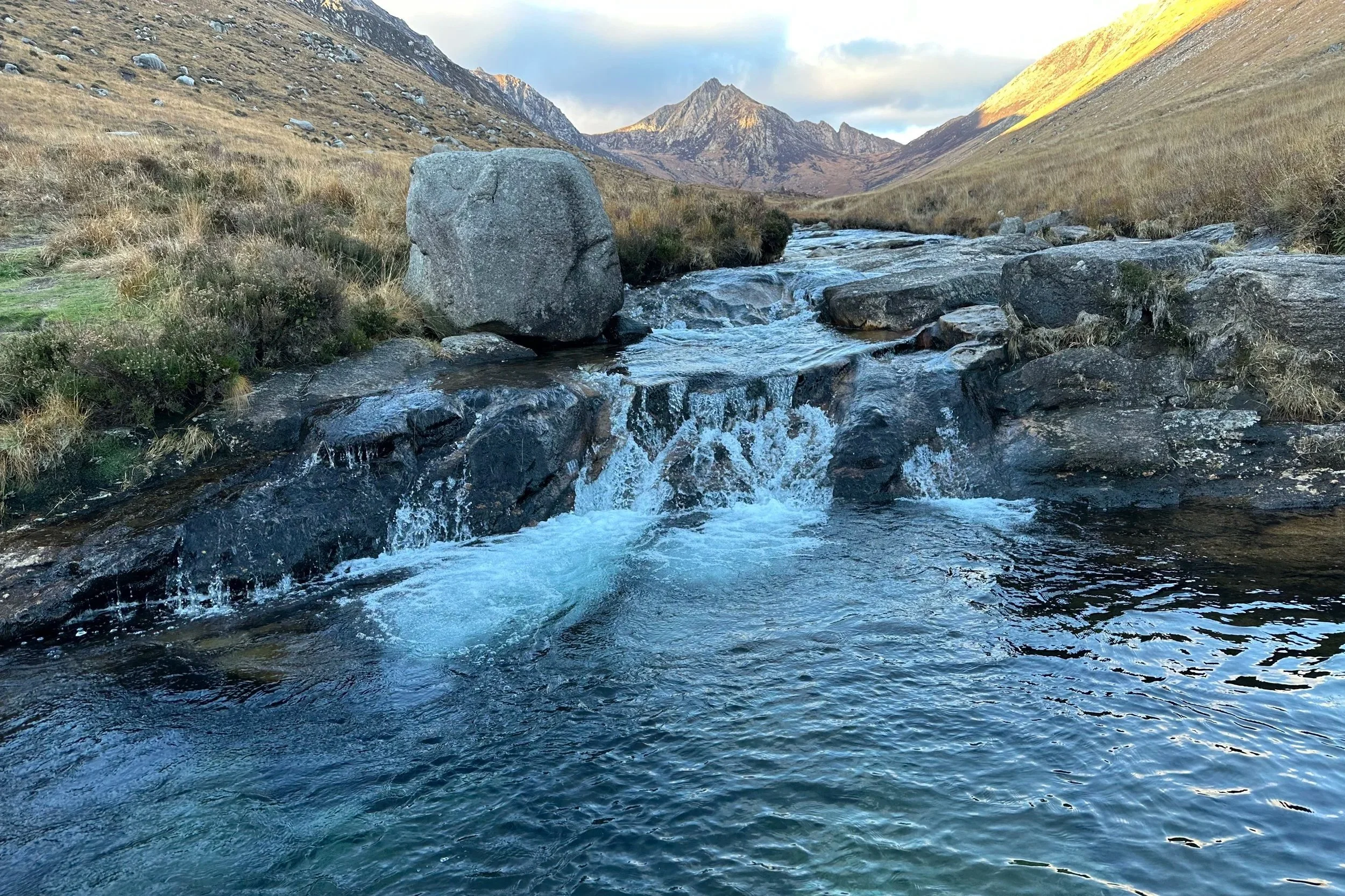
The Arran Granite: Learn about the Paleogene granite intrusions that form the rugged peaks of northern Arran, including Goatfell.
Glacial landscapes: Discover how glaciers sculpted the granite mountains, creating dramatic valleys, ridges and corries.
Lochranza: Examine the geological landscape around the northern tip of the island.
We'll finish the day in Brodick, where we'll spend the evening surrounded by Arran's spectacular mountains.
Overnight: Brodick
Day 2: Hutton’s Unconformity and the Sedimentary rocks of Northern Arran
Today, we'll explore one of Arran's most historically significant geological locations: Hutton's Unconformity at Lochranza.
This remarkable geological feature provides evidence of a huge gap in geological time and helped establish the foundations of modern geology.
Geological highlights:
Hutton's Unconformity: Visit the famous geological locality where Carboniferous sedimentary rocks rest unconformably upon much older Dalradian metamorphic rocks.
Deep geological time: Discover how James Hutton's observations challenged historical ideas about the age of the Earth.
Carboniferous environments: Examine sedimentary rocks that record ancient rivers, coastal environments and changing sea levels.
Sedimentary structures: Identify bedding, sedimentary textures and evidence of changing depositional environments.
Glen Rosa and the granitic pluton
Geological mapping: Learn how geologists use rock relationships and structures to reconstruct Earth's history.
We'll explore additional coastal exposures around northern Arran, with opportunities to examine the relationships between the island's metamorphic, sedimentary and igneous rocks.
Overnight: Brodick
Day 3 – The geology of southern Arran: Fossils, desert sandstones and ancient environments
Today, we head south to explore the younger sedimentary rocks of Arran, discovering how the island's geological history records changing environments, from tropical seas and river systems to arid deserts.
Southern Arran is particularly famous for its Carboniferous and Permian sedimentary rocks, which preserve fascinating evidence of ancient landscapes and life.
Geological highlights:
Carboniferous fossils: Explore suitable coastal exposures for evidence of ancient marine environments and fossil life.
Permian desert sandstones: Discover how vast desert environments left behind distinctive red sandstone deposits.
Sedimentary structures: Examine cross-bedding, ripple marks and other features that help geologists interpret ancient environments.
Igneous intrusions: Discover how magma intruded into existing sedimentary rocks, forming dykes and other igneous bodies.
Kildonan coastline: Explore the beautiful southern coast and its varied geological exposures.
Throughout the day, we'll discuss how Scotland's position on the globe changed over geological time and how these changes influenced the formation of Arran's rocks.
Overnight: Brodick
Day 4 – Volcanic Arran: Igneous Intrusions, coastal geology and the return journey
Our final day explores Arran's remarkable igneous geology, with a focus on the island's Paleogene magmatic activity and the geological processes that accompanied the opening of the North Atlantic Ocean.
We'll travel to western Arran, where spectacular coastal exposures reveal evidence of magma intruding into older sedimentary rocks.
Geological highlights:
Drumadoon Point: Explore the spectacular igneous sill and columnar jointing exposed along Arran's western coastline.
Paleogene magmatism: Discover how Arran formed part of the widespread igneous activity associated with the opening of the North Atlantic.
Igneous intrusions: Learn how to distinguish between intrusive and extrusive igneous rocks and recognise the structures produced as magma cools.
Coastal erosion: Examine how different rock types influence the shape of Arran's coastline.
Scotland's geological story: Bring together the metamorphic, sedimentary and igneous history explored throughout the four days.
We'll return to Brodick in the afternoon to catch the ferry back to the mainland, bringing our four-day geological adventure to a close.
Tour finishes: Mainland ferry terminal, subject to the confirmed sailing.
Who Should Attend?
Geology enthusiasts and students eager to see world-famous outcrops.
Walkers, families, and nature lovers looking to understand Arran’s landscapes more deeply.
Anyone curious about James Hutton and the birth of modern geology.
No prior geological knowledge needed—just sturdy footwear and a sense of curiosity!
Event Details
📍 Location: Isle of Arran, Firth of Clyde
Pick up: from Glasgow outside costa coffee, 50 George square, Glasgow city centre or meet us there
🗓️ Dates: Friday 30th July (10:00) to 2nd August 2027 (17:00)
⏰ Duration: 4 days
🎟️ Price:£450pp from Glasgow.
(Includes guiding, transport and ferry tickets. Accommodation is not included - please book accommodation within a 5 mile radius of Brodick)
Places we will visit:
Brodick
Corrie
North Glen Sannox
Glen Sannox
Arran geopark
Lochranza
Blackwaterfoot (drumadoon)
Kildonan
Kilmory
Whitting bay
Glen Rosa
Why Join This Tour?
Arran has been called a “geological textbook” in the field, and with @ScottishGeologist as your guide, you’ll explore its unconformities, volcanoes, fossils, and glacial landscapes in a way that connects science, scenery, and story.
Book Your Arran Geology Tour Today!
Uncover the island where Scotland’s geology comes together—and where the science of deep time was born.
Tour will be confirmed once 3 people book on.
Scotland in Miniature: A Geology Tour of the Isle of Arran with @ScottishGeologist
Join @ScottishGeologist for an inspiring geological tour of the Isle of Arran, often called “Scotland in Miniature” because it showcases almost every type of rock and geological process found across the country. From ancient ocean crust found In north Glen Sannox along the Highland Boundary fault line to folded meta-sediments that were deformed during the Caldeonian orogeny (mountain building) to the granite mountains, fossil-rich sandstones, and famous unconformities, Arran is one of the best places in the world to explore Earth’s story in a single island.
What to Expect
🌍 Deep Time on Display
Walk through hundreds of millions of years of Earth history in a single island, from Precambrian metamorphic rocks to Tertiary granites and dykes.
Understand why Arran is nicknamed “Scotland in Miniature”—its rocks represent almost every major stage of Scotland’s geological story.
🪨 Hutton’s Unconformity at Lochranza
Stand at the site where James Hutton, the father of modern geology, found one of his most famous examples of unconformity.
See how vertical Dalradian schists (c. 500–600 million years old) are overlain by much younger Devonian sandstones (~370 million years old).
Learn how this relationship gave Hutton evidence for “deep time” and the endless cycles of rock formation.
🌋 Igneous Geology: The Arran Granite and Beyond
• Explore the granite mountains of North Arran, intruded around 60 million years ago during the opening of the North Atlantic.
• Learn how slow-cooling magma deep underground produced the rugged Goatfell massif.
• Trace dyke swarms that cut through older rocks, part of the same magmatic activity that shaped Skye and Mull.
• See where igneous intrusions altered surrounding rocks by metamorphism (contact aureoles).
🧭 Structural Geology and Tectonics
Identify folds and faults in Dalradian metamorphic rocks.
Learn how these structures formed during the Caledonian Orogeny (~430 million years ago), when Scotland was part of a giant mountain belt like today’s Himalayas.
Discuss how later extension and volcanism reshaped the island
👣 Hands-On Exploration
Use simple field skills: sketching outcrops, noting sedimentary structures, and identifying igneous textures.
Compare rocks of very different ages side by side.
See how Arran acts as a “natural classroom,” ideal for connecting big geological ideas with real-world rocks.
🏜️🏝️Sedimentary Stories
Walk across Devonian Old Red Sandstone, laid down in rivers and desert basins when Scotland lay near the equator.
Visit Carboniferous rocks with limestones, sandstones, and shales, packed with fossils of corals, crinoids, and plants, evidence of warm shallow seas and swampy deltas.
Examine the Permian sandstones of southern Arran, deposited in arid desert conditions, their vivid red colour still striking today.
Itinerary
Glasgow - Ardrossan - Isle of Arran – Glasgow/Ardrossan
Day 1 – The Northern highlands of Arran – Ancient rocks and granitic mountains
Our adventure begins with the ferry crossing to Arran, arriving at Brodick. From here, we'll travel north into the island's mountainous landscape, exploring the geological history of northern Arran.
Northern Arran is dominated by ancient metamorphic rocks and the spectacular Paleogene granite intrusion responsible for creating some of the island's most dramatic mountain scenery.
Geological highlights:
The Highland Boundary Fault: Discover how this major geological structure separates the older metamorphic rocks of northern Arran from the younger sedimentary rocks to the south.
Dalradian metamorphic rocks: Explore rocks formed from ancient sediments that were subsequently deformed and metamorphosed during the Caledonian Orogeny.
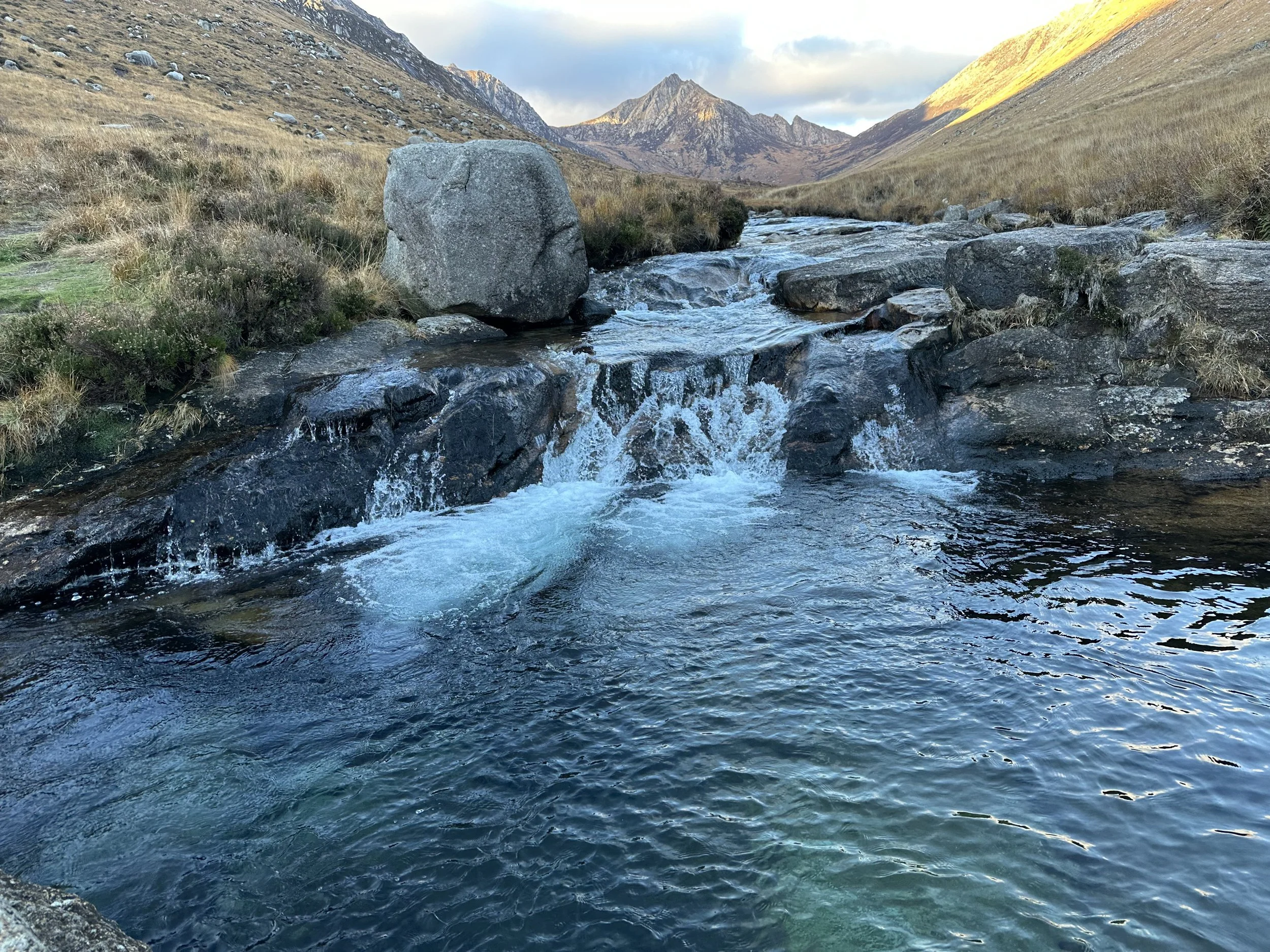
The Arran Granite: Learn about the Paleogene granite intrusions that form the rugged peaks of northern Arran, including Goatfell.
Glacial landscapes: Discover how glaciers sculpted the granite mountains, creating dramatic valleys, ridges and corries.
Lochranza: Examine the geological landscape around the northern tip of the island.
We'll finish the day in Brodick, where we'll spend the evening surrounded by Arran's spectacular mountains.
Overnight: Brodick
Day 2: Hutton’s Unconformity and the Sedimentary rocks of Northern Arran
Today, we'll explore one of Arran's most historically significant geological locations: Hutton's Unconformity at Lochranza.
This remarkable geological feature provides evidence of a huge gap in geological time and helped establish the foundations of modern geology.
Geological highlights:
Hutton's Unconformity: Visit the famous geological locality where Carboniferous sedimentary rocks rest unconformably upon much older Dalradian metamorphic rocks.
Deep geological time: Discover how James Hutton's observations challenged historical ideas about the age of the Earth.
Carboniferous environments: Examine sedimentary rocks that record ancient rivers, coastal environments and changing sea levels.
Sedimentary structures: Identify bedding, sedimentary textures and evidence of changing depositional environments.
Glen Rosa and the granitic pluton
Geological mapping: Learn how geologists use rock relationships and structures to reconstruct Earth's history.
We'll explore additional coastal exposures around northern Arran, with opportunities to examine the relationships between the island's metamorphic, sedimentary and igneous rocks.
Overnight: Brodick
Day 3 – The geology of southern Arran: Fossils, desert sandstones and ancient environments
Today, we head south to explore the younger sedimentary rocks of Arran, discovering how the island's geological history records changing environments, from tropical seas and river systems to arid deserts.
Southern Arran is particularly famous for its Carboniferous and Permian sedimentary rocks, which preserve fascinating evidence of ancient landscapes and life.
Geological highlights:
Carboniferous fossils: Explore suitable coastal exposures for evidence of ancient marine environments and fossil life.
Permian desert sandstones: Discover how vast desert environments left behind distinctive red sandstone deposits.
Sedimentary structures: Examine cross-bedding, ripple marks and other features that help geologists interpret ancient environments.
Igneous intrusions: Discover how magma intruded into existing sedimentary rocks, forming dykes and other igneous bodies.
Kildonan coastline: Explore the beautiful southern coast and its varied geological exposures.
Throughout the day, we'll discuss how Scotland's position on the globe changed over geological time and how these changes influenced the formation of Arran's rocks.
Overnight: Brodick
Day 4 – Volcanic Arran: Igneous Intrusions, coastal geology and the return journey
Our final day explores Arran's remarkable igneous geology, with a focus on the island's Paleogene magmatic activity and the geological processes that accompanied the opening of the North Atlantic Ocean.
We'll travel to western Arran, where spectacular coastal exposures reveal evidence of magma intruding into older sedimentary rocks.
Geological highlights:
Drumadoon Point: Explore the spectacular igneous sill and columnar jointing exposed along Arran's western coastline.
Paleogene magmatism: Discover how Arran formed part of the widespread igneous activity associated with the opening of the North Atlantic.
Igneous intrusions: Learn how to distinguish between intrusive and extrusive igneous rocks and recognise the structures produced as magma cools.
Coastal erosion: Examine how different rock types influence the shape of Arran's coastline.
Scotland's geological story: Bring together the metamorphic, sedimentary and igneous history explored throughout the four days.
We'll return to Brodick in the afternoon to catch the ferry back to the mainland, bringing our four-day geological adventure to a close.
Tour finishes: Mainland ferry terminal, subject to the confirmed sailing.
Who Should Attend?
Geology enthusiasts and students eager to see world-famous outcrops.
Walkers, families, and nature lovers looking to understand Arran’s landscapes more deeply.
Anyone curious about James Hutton and the birth of modern geology.
No prior geological knowledge needed—just sturdy footwear and a sense of curiosity!
Event Details
📍 Location: Isle of Arran, Firth of Clyde
Pick up: from Glasgow outside costa coffee, 50 George square, Glasgow city centre or meet us there
🗓️ Dates: Friday 30th July (10:00) to 2nd August 2027 (17:00)
⏰ Duration: 4 days
🎟️ Price:£450pp from Glasgow.
(Includes guiding, transport and ferry tickets. Accommodation is not included - please book accommodation within a 5 mile radius of Brodick)
Places we will visit:
Brodick
Corrie
North Glen Sannox
Glen Sannox
Arran geopark
Lochranza
Blackwaterfoot (drumadoon)
Kildonan
Kilmory
Whitting bay
Glen Rosa
Why Join This Tour?
Arran has been called a “geological textbook” in the field, and with @ScottishGeologist as your guide, you’ll explore its unconformities, volcanoes, fossils, and glacial landscapes in a way that connects science, scenery, and story.
Book Your Arran Geology Tour Today!
Uncover the island where Scotland’s geology comes together—and where the science of deep time was born.
Tour will be confirmed once 3 people book on.